Traces of the Ahl-e Bait at Moula ʿAlī in Hyderabad, India
Relics, Remains, and Traces in Islam
Ethnographic fieldwork in the Deccan. February – March 2020 | Research outcomes: 1 peer-reviewed book chapter [forthcoming]
The perimeter of Golconda – and what was to become the city of Moula ʿAlī (My Lord ʿAlī) or Hyderabad (Abode of ʿAlī) – in the Deccan region of southcentral India is marked by auspicious impressions made in stone of hands and feet. Serving as apotropaic and protective signs, the earliest of these body relics date to the early Quṭb Shāhī period (ca. 1518–1687 CE). The Quṭb Shāhīs consciously sought to integrate Persianate and Shīʿī forms with indigenous religious traditions and practices of the Deccan and, in turn, promoted certain syncretic Shīʿī practices.
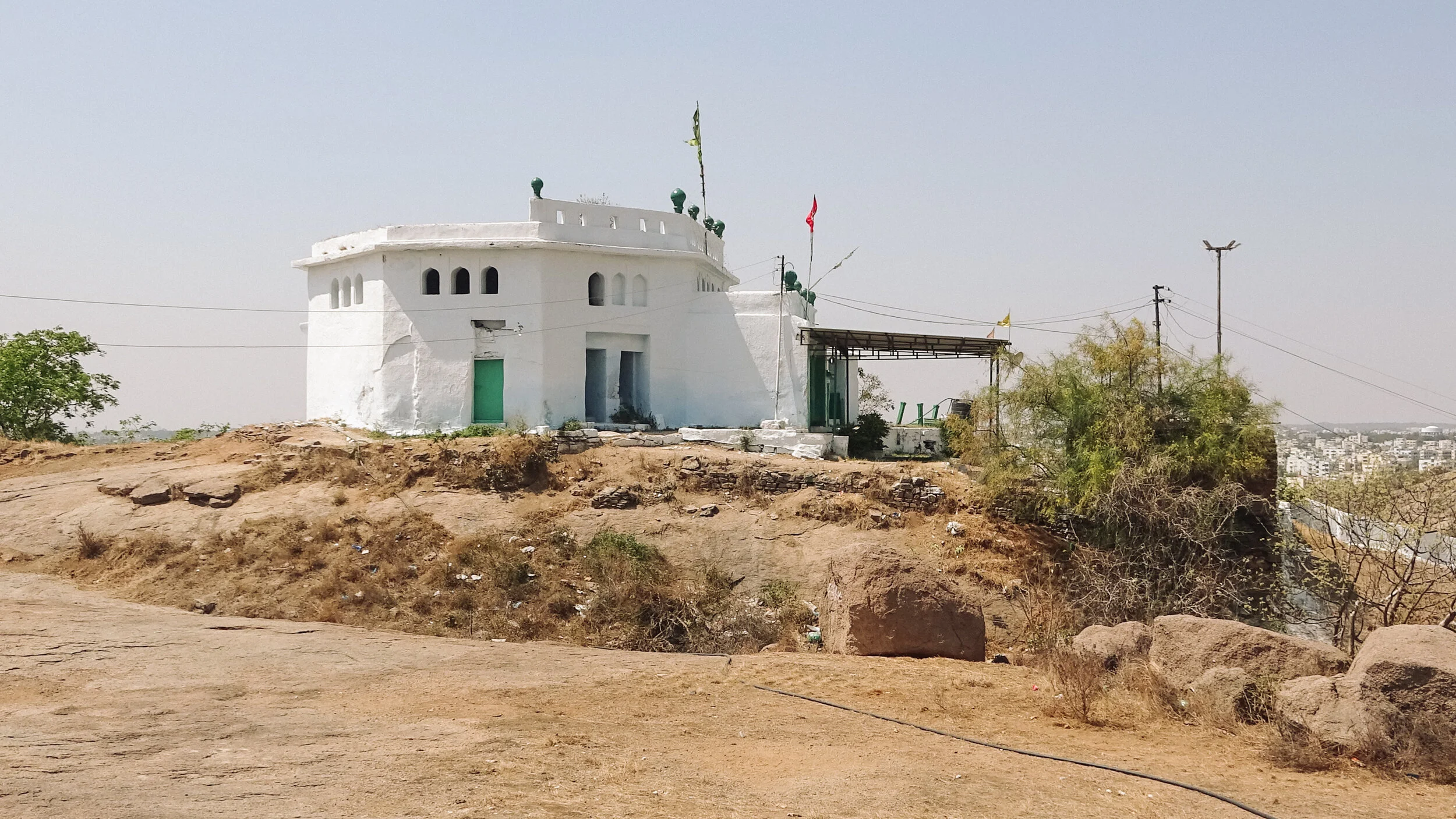
One of the most important Shīʿī shrines, built in 1578 during the reign of Ibrahim Quṭb Shāh (r. 1550–1580), protects the right handprint of Imam ʿAlī. The autochthonous relic (tabarrukāt) is preserved on a rocky dome-shaped hillock on the outskirts of Hyderabad. According to tradition, ʿAlī, the cousin of the Prophet Muḥammad and husband of the Prophet’s daughter Fatima, visited Hyderabad, named after one of ʿAlī’s epithets, Ḥaydar (‘Lion’), and left this physical mark in stone. Yāqūt (‘Ruby’), a senior eunuch in the court of Ibrahim, fell ill. One Thursday, on 17 Rajab, he had a visionary dream in which a man, dressed in green clothing (probably the immortal Khizr) came to tell him that he was being called by Moula ʿAlī, who asked him to climb a hillock (later called Moula ʿAlī hill). There ʿAlī would be waiting for him to cure him of his illness. Yāqūt did as he was told and indeed saw the Imam on the summit of the hill with his right hand resting upon a rock. The next morning Yāqūt was cured, and found the mark of ʿAlī’s hand impressed in the rock at the site where he had seen him in the dream. To commemorate the event, he ordered the handmark to be hewn out of the stone. After hearing about this miracle, sultan Ibrahim visited the hill and ordered a hilltop shrine (dargāh) to be built at the spot, known as Koh-e Moula ʿAlī, which became a center for pilgrimage for different Hindu and Muslim communities alike. Then as now, Hindu pilgrims often outnumber Muslims. The sacred site preserves the body relic of ʿAlī, which is believed to have healing powers. Locally people refer to ʿAlī as ‘deliverer from suffering,’ and make votive offerings to request his aid and deliverance from suffering. Inside the dargāh, which houses the relic, there is a tree, to which padlocks are attached by devotees, each symbolizing a wish to be fulfilled. Once the wish has been fulfilled, the supplicants return and remove the lock.


Half-way up to the dargāh at the summit is the dargāh of Hazrat Abbas, son of ʿAlī and half-brother of Imam Hussain, also martyred at Karbala while trying to fetch water to quench the thirst of the children at Imam Hussain’s camp. The dargāh bears further contact relics such as processional standards (ʿalams) surmounted by an outstretched hand (panjāh). There is a small cave and a spring. Newly-married couples bring the flowers exchanged during marriage rituals to the spring to seek blessings.
Moula ʿAlī hill is connected to two other sacred hillocks. The one opposite is known as the Qadam-e Rasool (relic of the Prophet) because of the sacred footprint of the Prophet Muḥammad which was acquired by Muhammad Shukrullah Khan, a servant of Mir Nizam Ali Khan, Asaf Jah II (r. 1762–1803), the second Nizam of Hyderabad Deccan. Next to the Qadam-e Rasool is the Ashoorkhana Bargah Fatima Zahra, referring to Fāṭimah al-Zahrāʾ, the daughter of the Prophet and wife of ʿAlī. There are no relics on this hillock.